e.Lens Energy · ISO 52016-1 physical model

Automated, auditable
energy assessment for residential buildings

e.Lens Energy works in two steps. Portfolio Screening assesses an entire portfolio of residential buildings in seconds, without a site visit. Pre-Audit verifies a single building in about 15 minutes: the owner or an inspector takes photos in a mobile app. Every result shows the parameters and sources it was built from.

Built around: EPBD 2024/1275 ISO 52016-1 CSRD EBA GL
2.4s
scan time per building from address
0
technician visits for Portfolio Screening
~15min
Pre-Audit via mobile app
15k+
residential buildings in validation
Standards & regulations EPBD 2024/1275 ISO 52016-1 ISO 52000-1 EBA GL Loan Origination CSRD CRR / CRD IV
The challenge

The energy data exists,
but without provenance

Building energy assessment today is either fast and uncertain (declarations, market averages) or accurate and expensive (an on-site audit). e.Lens Energy covers both needs: Portfolio Screening gives a picture of the whole portfolio, and Pre-Audit verifies the buildings where the data is uncertain.

EP
A value without a source

In many databases a building's energy class comes from a declaration or a market average. When an auditor asks where the EP value for a specific building in a specific quarter came from, it is hard to show. Portfolio Screening shows the parameters behind every result.

27
EU countries, different energy certificate methods

Energy certificates in institutional databases often rely on simplified methods or outdated data. The European Commission names the low reliability and inconsistency of certificates as a barrier to the energy transition.* e.Lens Energy calculates every building with one method and keeps a record of the calculation.

2026
EPBD 2024 in national law

In 2026 EU countries transpose the EPBD 2024/1275 directive into national law. Institutions need to know which buildings have the weakest energy classes and how their performance changes after modernisation.

Portfolio Screening gives a picture of the whole portfolio without a site visit. Pre-Audit fills the gaps where the data is uncertain, under a Proof-of-Presence standard: every photo taken in the app carries a GPS location, a timestamp and intact metadata, so it is clear it was taken at that building.

Who it is for

Data for regulatory requirements

The e.Lens Energy calculation logic is built on ISO 52016-1 and the EPBD 2024 directive.

ESG risk in the mortgage portfolio

For risk management (Model Risk) and ESG directors: an auditable baseline for transition risk assessment with reference to the EBA Guidelines on Loan Origination and Monitoring.

  • Portfolio Screening and gap filling (Pre-Audit): the platform first reviews the whole portfolio and flags buildings with missing or uncertain data. For those buildings the owner or an inspector fills the gaps in the mobile app.
  • CSRD and EU Taxonomy: incomplete address records become estimates of primary energy demand and emissions for the portfolio (Scope 3, financed emissions).
  • Collateral value (Pillar 3): flags properties at risk of losing value as Minimum Energy Performance Standards (MEPS) tighten.
  • Audit trail: every estimate is rooted in building physics and ISO 52016-1, so auditors and supervisors can trace every result.
Talk to us about a pilot →
Every result with its parameters
and source

An energy map of residential buildings

For municipalities, local governments and public institutions: an overview of the energy performance of residential buildings in their area, for example when planning thermal modernisation programmes.

  • Portfolio Screening and verification (Pre-Audit): the platform flags buildings that need more data, and the owner or an inspector adds it by smartphone in about 15 minutes. Every photo carries a GPS location and a timestamp, which reduces the risk of fictitious grant applications.
  • EPBD directive: identifies the worst-performing buildings (classes F and G), so modernisation funds go where they are needed most.
  • Heat pumps and renewables: analysis of the potential for heat pumps and renewable energy in residential buildings, based on their technical parameters.
  • Funds and grants: data to secure and account for EU funds, green bonds and grants for building modernisation.
Talk to an expert →
Portfolio Screening A-G classes
for the whole stock
How it works

How e.Lens Energy works

We transform raw, incomplete address data into validated, auditable energy performance metrics in five automated steps.

Portfolio Screening: how it works
dashboard.elens.io
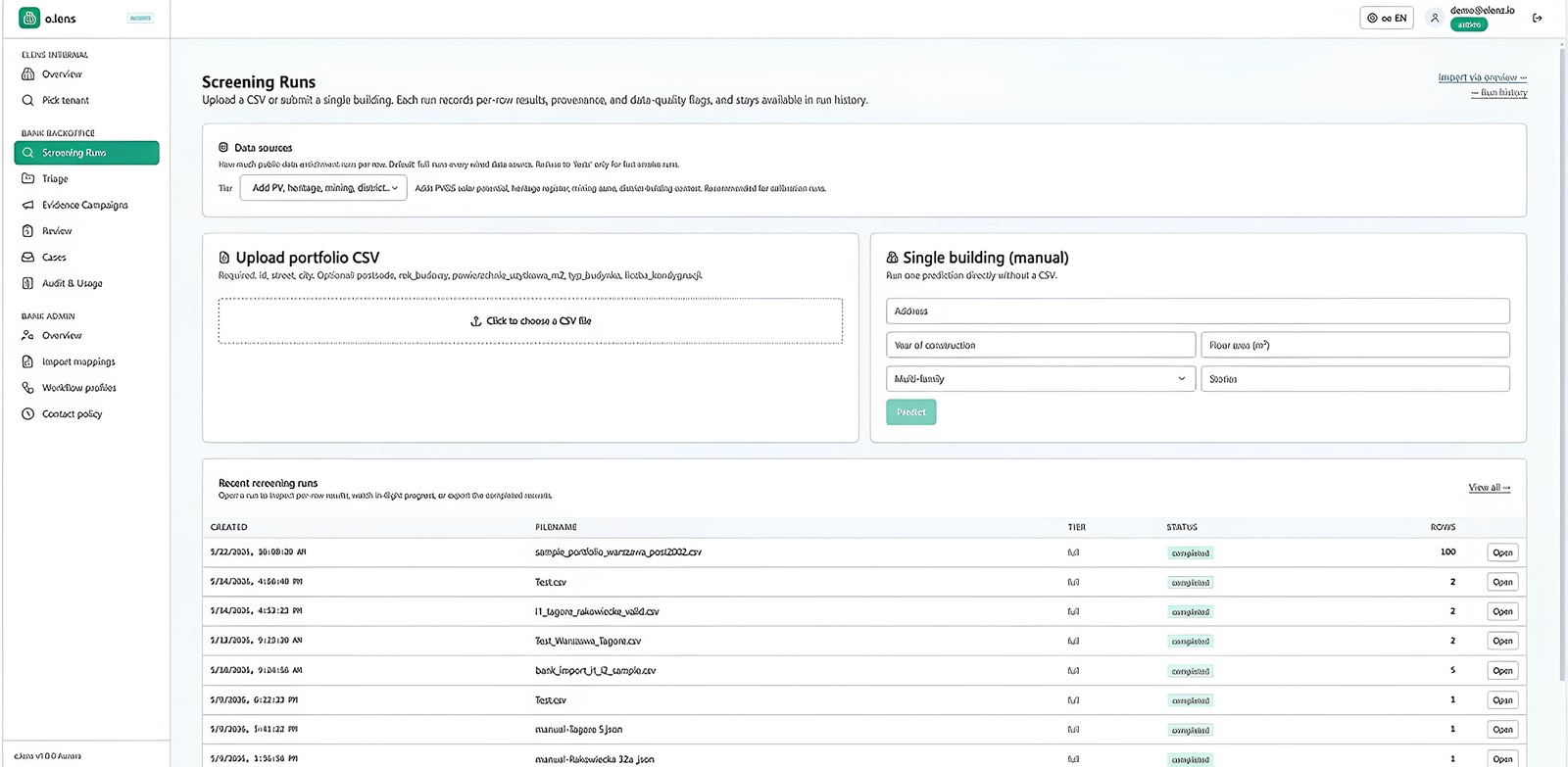
Ekran wgrywania pliku CSV z adresami budynków do e.Lens Energy
1 Portfolio Screening · Step 1

Upload your address portfolio

The institution uploads a CSV file or connects via API. The system accepts data and starts automated screening of all properties simultaneously.

2 Portfolio Screening · Step 2

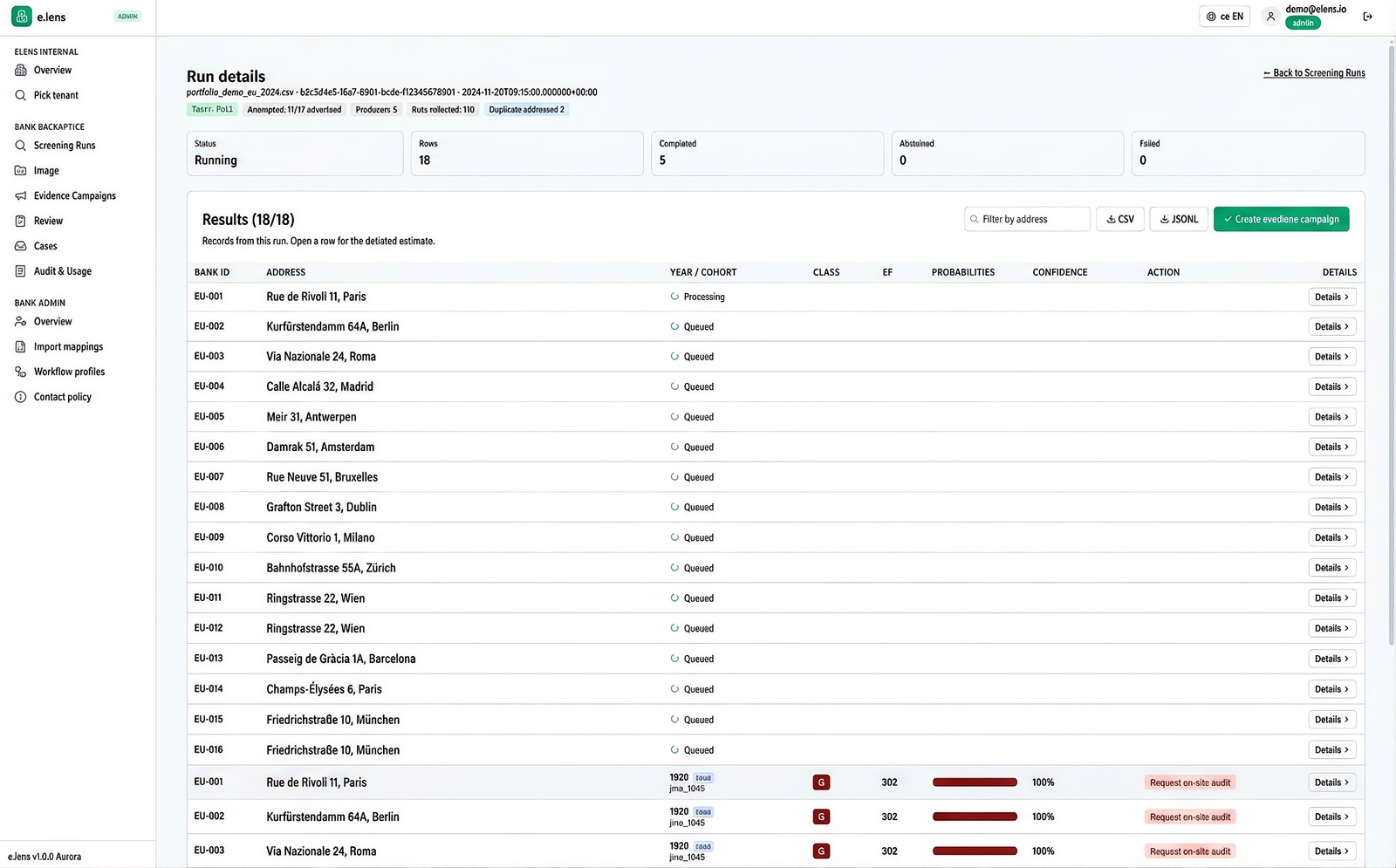
Automated screening

The e.Lens Energy engine gathers building data from registries, geoportals and climate data. Within seconds it assigns an A-G energy class to every building in the portfolio, based on the ISO 52016-1 physical model.

dashboard.elens.io
Panel Portfolio Screening: automatyczny screening energetyczny budynków
dashboard.elens.io
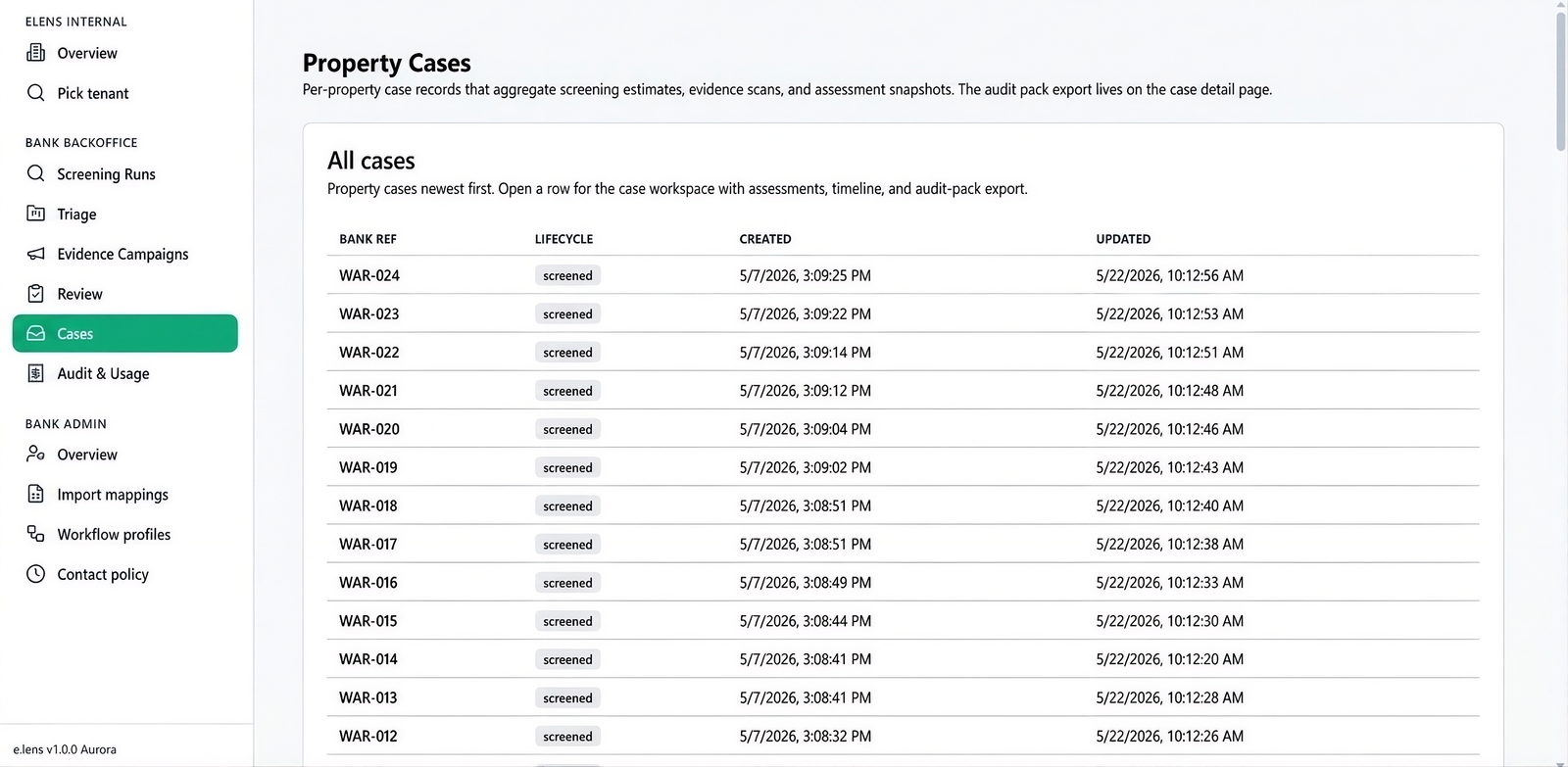
Lista Property Cases: budynki po screeningu z historią audytu
3 Portfolio Screening · Step 3

Property Cases: operator view

Each building gets its own case with aggregated data, screening history and full audit trail. The user sees the status of every property in real time.

4 Portfolio Screening · Step 4

Results: A-G classes with confidence level

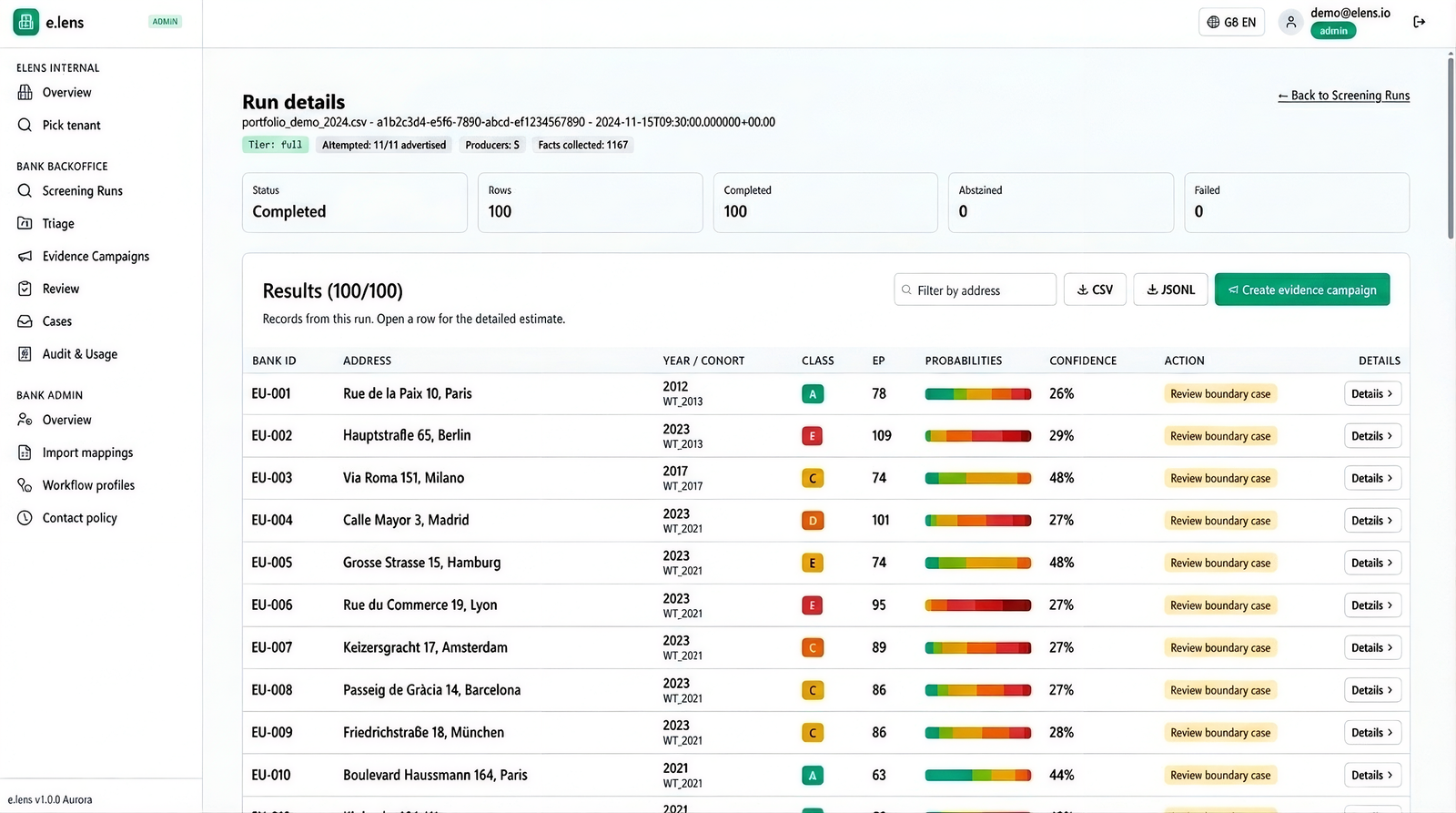
Results table shows energy class, EP value in kWh/m²/yr, class probability distribution and confidence level per building. Export to CSV or JSONL.

dashboard.elens.io
Wyniki screeningu: klasy energetyczne A-G z poziomem pewności
dashboard.elens.io
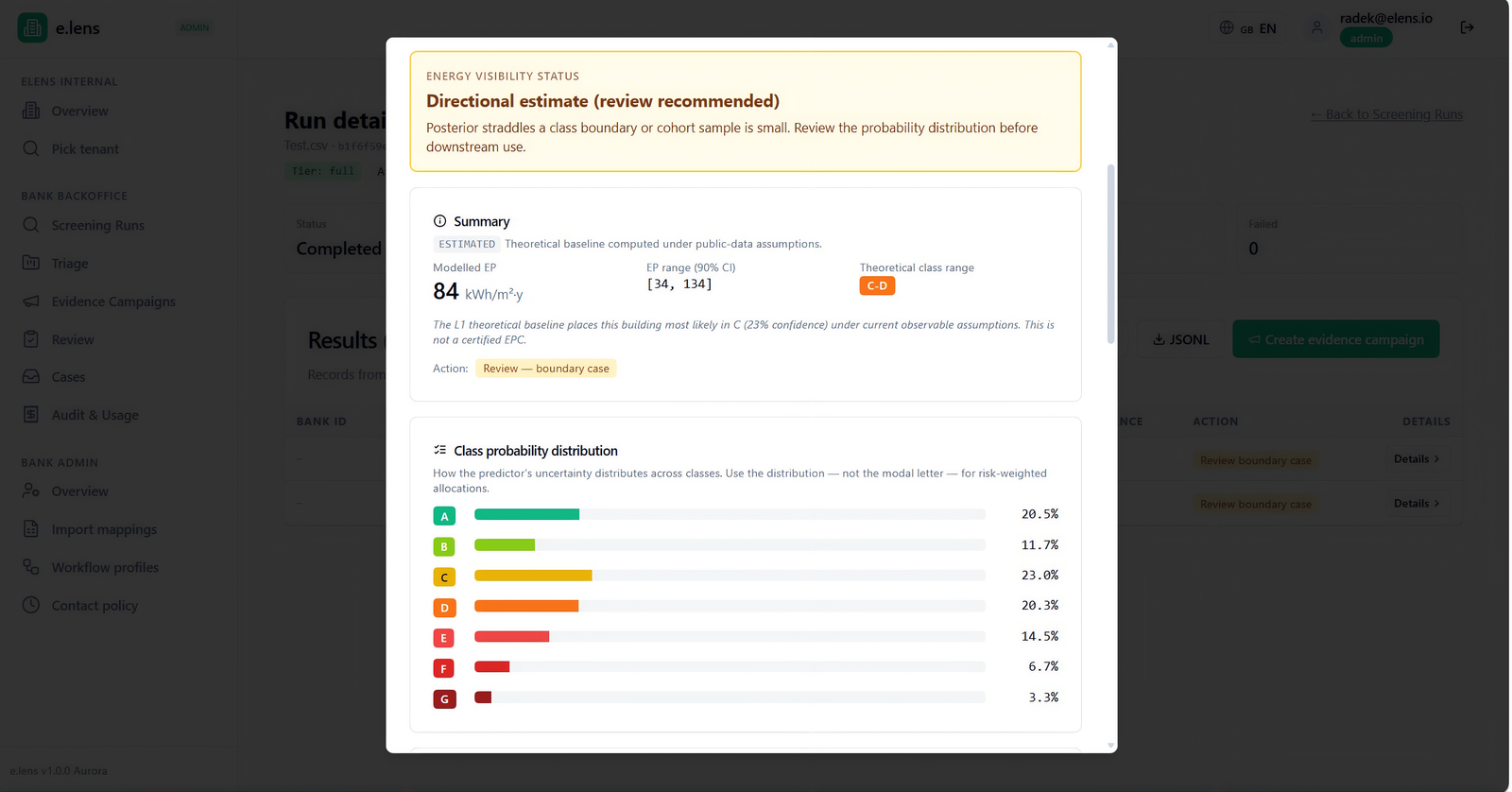
Szczegółowy raport energetyczny budynku z przedziałem ufności 90%
5 Portfolio Screening · Step 5

Detailed report with confidence interval

Every building has a report with the EP model, a 90% confidence interval, the A-G class distribution and a recommended action. It supports credit decisions, grant programme planning and ESG and CSRD reporting.

Pre-Audit: mobile app, available for testing
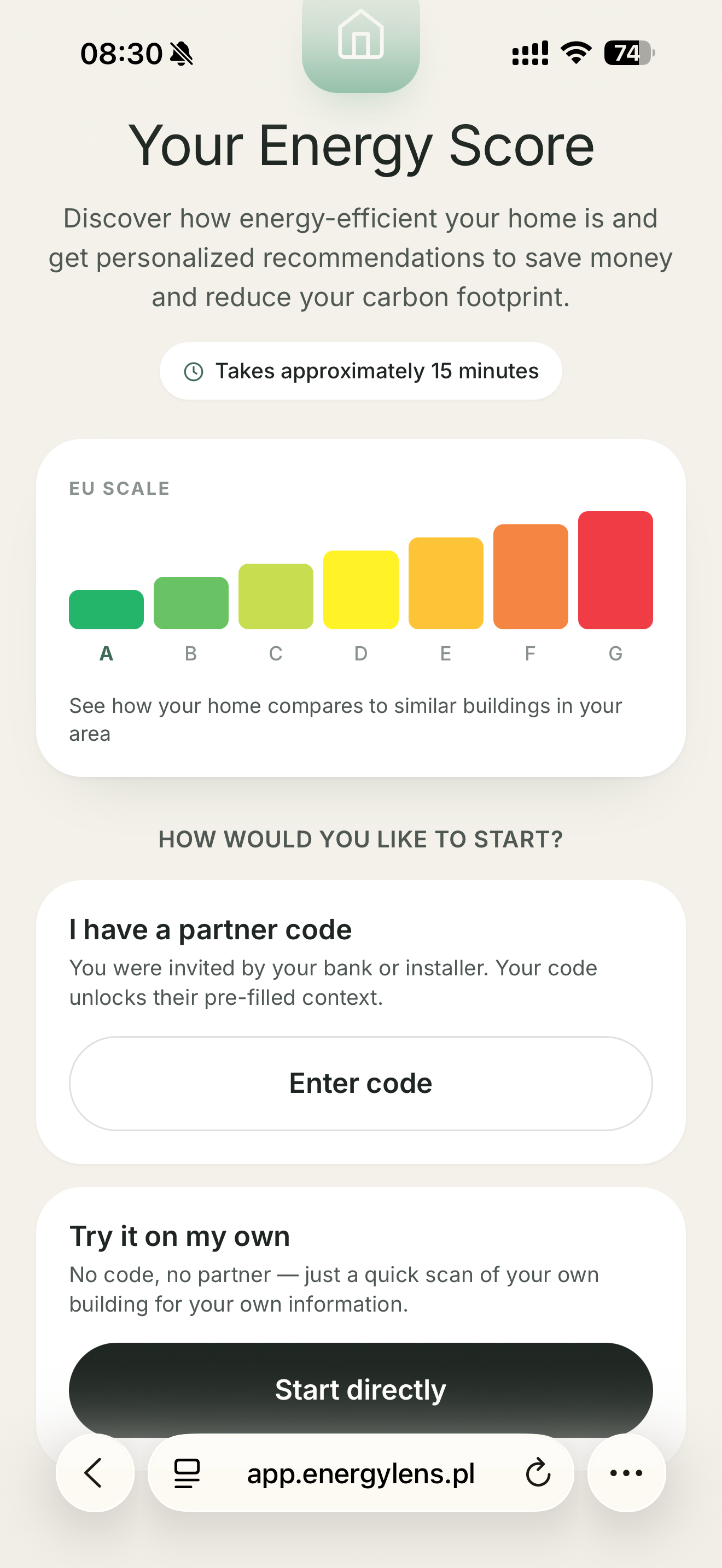
Ekran startowy aplikacji Pre-Audit e.Lens Energy
1 Pre-Audit · Step 1

Invitation & app start

The property owner receives a link from the bank or institution, opens the Pre-Audit app and goes through their building in about 15 minutes, without a technician visit.

2 Pre-Audit · Step 2

Building data from the owner

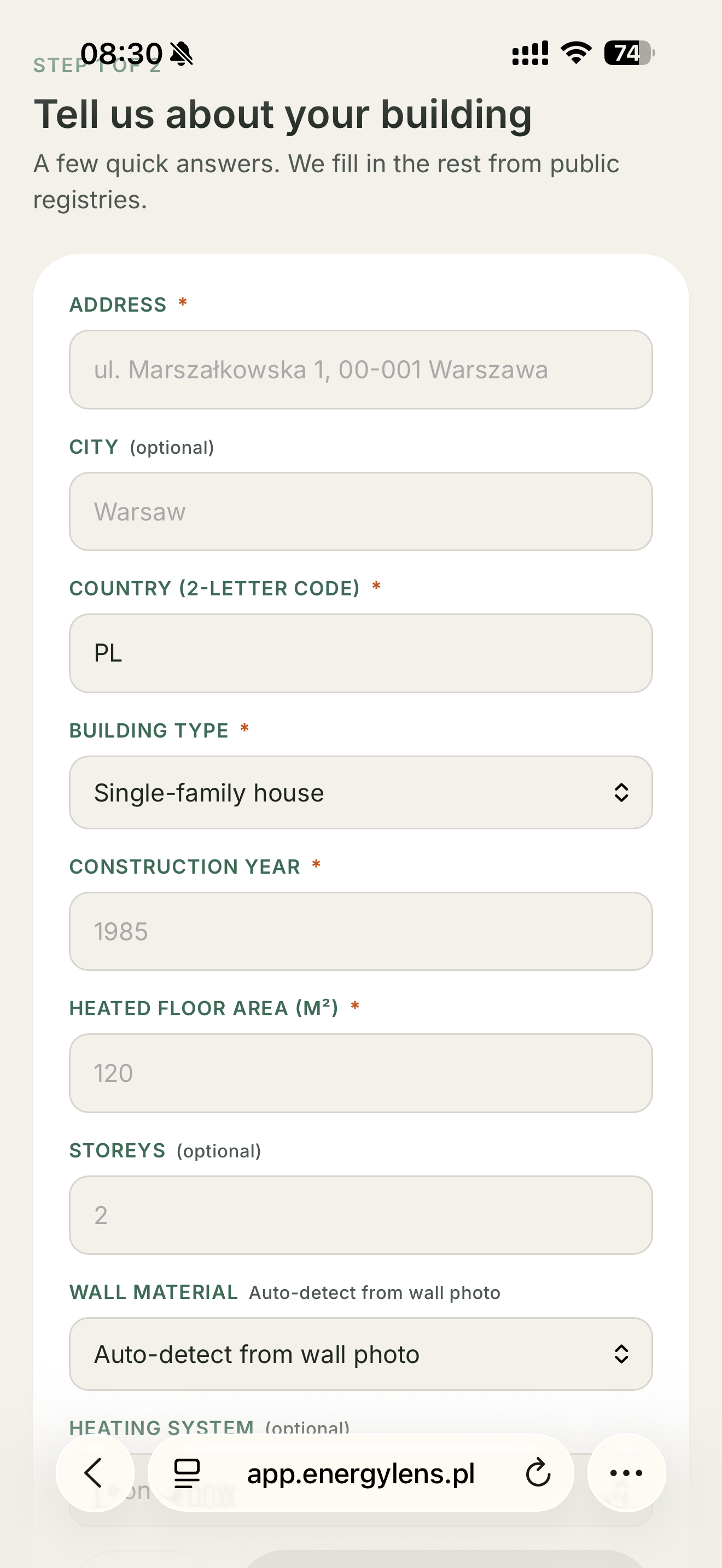
The owner provides basic data: address, building type, year of construction, floor area. The rest is filled automatically from registries.

Formularz danych budynku w aplikacji Pre-Audit
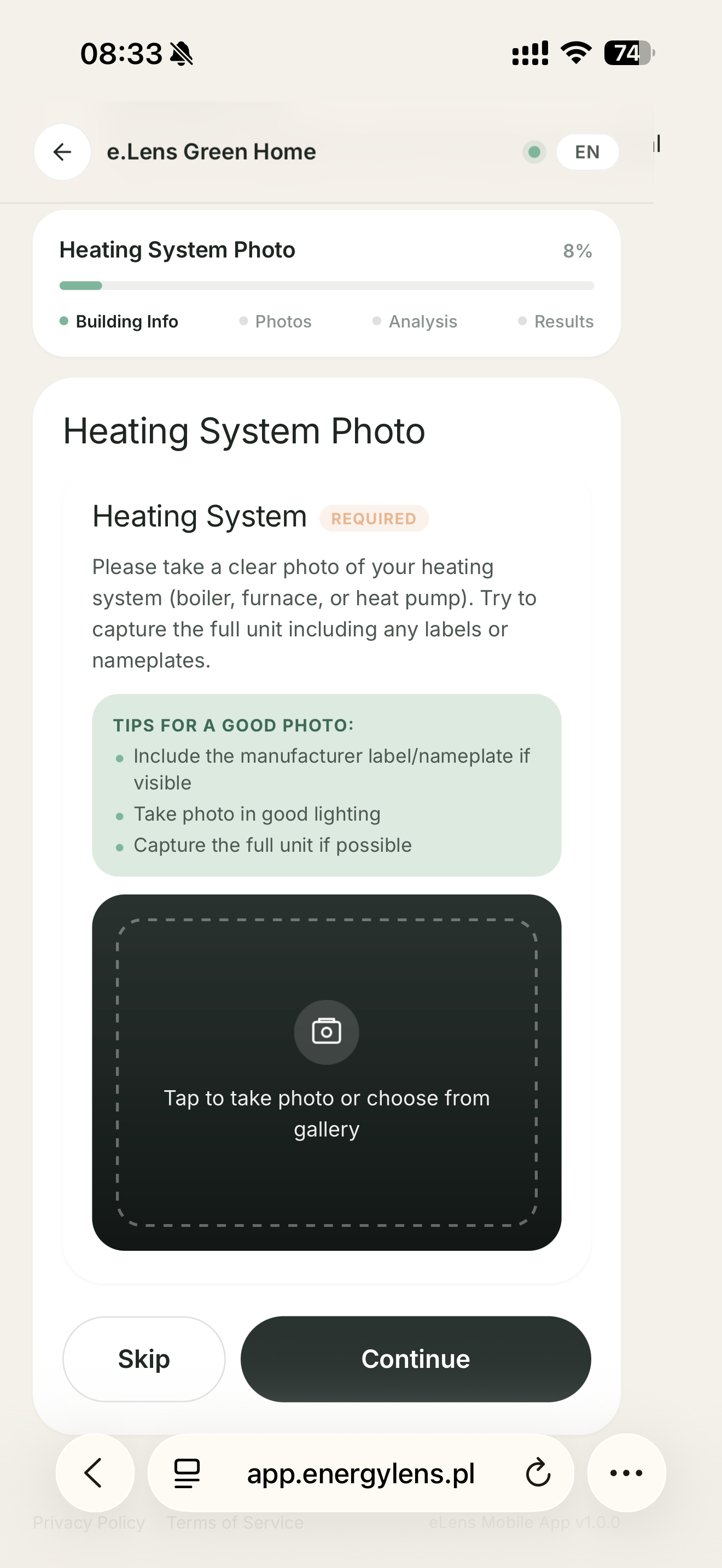
Zdjęcia elementów budynku w aplikacji Pre-Audit: system grzewczy, okna, ściany
3 Pre-Audit · Step 3

Building elements scan

The owner photographs the building elements that matter for the energy assessment, including the heating system, windows, doors, walls, ventilation, air conditioning and other installations. The app guides the user step by step and records the GPS location of each photo.

4 Pre-Audit · Step 4

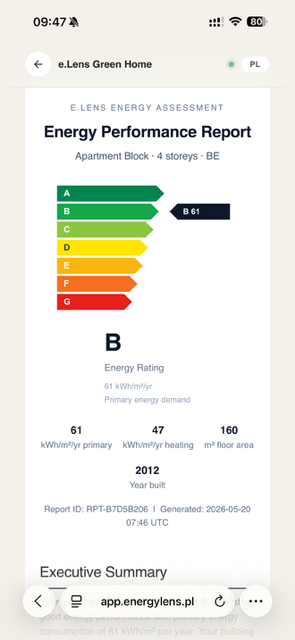
Final report with energy class

The owner and the bank receive a report with the energy class, EP value, year of construction and a description of the method (ISO 52016-1 physical model). The report does not replace an official energy performance certificate.

Raport końcowy Pre-Audit z klasą energetyczną budynku
One platform, several output formats.
Dashboard  ·  API  ·  PDF report  ·  Audit pack
CSRD EPC CO₂ ISO 52016-1
Public Sector  ·  Banks & ESG
Validation

Verified accuracy on real-world data

We validated the model on over 15,000 residential buildings, comparing the results with official energy performance certificates from the national registry.

−0.5EP
Bias · kWh/(m²·yr)
Near-zero systematic deviation of the model
90.5%
within ±50 EP band
Alignment with official building databases
15 000+
residential buildings
in the validation set
e.Lens Energy: podgląd tabeli wyników
23.0EP
MAE · kWh/(m² yr)
90.5%
results within ±50 EP band
−0.5EP
Bias: no systematic deviation
15 000+
validation buildings
18.1EP
MAE · high-quality subset
32.7EP
RMSE

Validated on Polish buildings, built for the whole of Europe

e.Lens Energy is designed for the European market. The first validation covered over 15,000 residential buildings in Warsaw, compared against the national energy performance certificate registry.

We tested e.Lens Energy on real-world data, not synthetic datasets. The results were compared directly with official energy performance certificates from the national registry.
Regulatory compliance

Designed for regulation,
not retrofitted after the fact

EPBD 2024/1275

Retrofit pathways

Identifies and ranks the worst-class buildings in a mortgage portfolio or a municipal housing stock.

ISO 52016-1

Calculation chain based on ISO 52016-1

EPB energy balance with functional checkpoints at every calculation step.

CSRD · EBA GL

Climate reporting

EP data for mortgage collateral and an audit trail for the model risk department.

RODO / GDPR

Privacy by design

Independent consent tracks per user and property. Personal data separated from computation data.

"e.Lens Energy does not guess energy classes. It is evidence infrastructure: every estimate has a source, a version and an uncertainty interval."

e.Lens Energy technical report 2026
Get started

Let's talk about a pilot

Send us a list of residential building addresses. We will return Portfolio Screening results with a description of the method, and you can test the Pre-Audit app on selected buildings.

Or write directly: contact@elens.io